Jaguar, Range Rover & Land Rover engine specialists
Range Rover Engine Rebuild & Replacement UK — independent specialists for SDV6, SDV8 & V8
A Range Rover's engine failure is rarely a cheap one — the 3.0 SDV6 crank snap, the 4.4 SDV8 twin-turbo wear, and the 5.0 supercharged V8 coolant pipe failure can all write off a vehicle if handled badly. JLRRebuilds.co.uk matches Range Rover owners with independent UK specialists who have rebuilt these exact engines: diagnosed first, quoted in writing, and warranted by the workshop that does the work. Whether you drive an Evoque, Sport, Vogue or Velar, your registration check confirms the right route for your engine.
Range Rover
Engine specialists
GET FREE ENGINE QUOTES
Enter your registration
We’ll identify your Jaguar or Land Rover and take you to a short contact form.
✓No obligation
✓Free vehicle lookup
✓UK specialists
Which Range Rover Engine Problem Are You Dealing With?
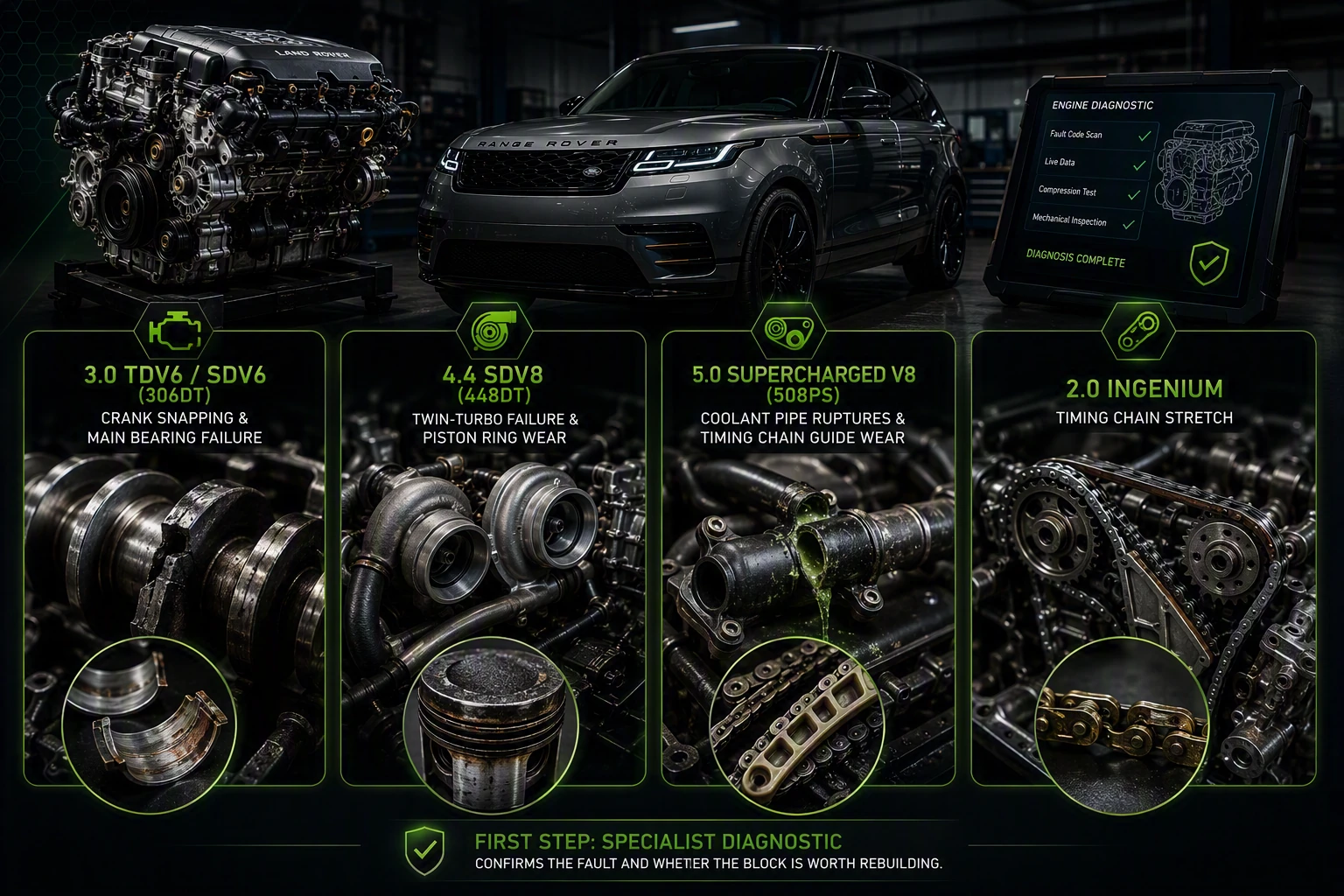
Range Rover engines fail in patterns, and knowing the pattern saves you money. The 3.0 TDV6/SDV6 (306DT) is famous for crank snapping and main bearing failure between roughly 60,000 and 120,000 miles. The 4.4 SDV8 (448DT) suffers twin-turbo failure and piston ring wear. The 5.0 supercharged V8 (508PS) develops coolant pipe ruptures and timing chain guide wear — and the 2.0 Ingenium in later Evoque and Velar models stretches its timing chain. Whatever your engine, the first step is the same: a specialist diagnostic that confirms the fault and whether the block is worth rebuilding.
Range Rover Models Covered and Their Known Engine Issues
| Model | Years | Engine Family | Engine Codes | Common Issue |
|---|---|---|---|---|
| Range Rover Evoque | 2011–2022 | Duratorq 2.2, Ingenium 2.0 | 224DT, 204DTD | Crank failure, timing chain stretch, balance shaft bearings |
| Range Rover Sport | 2005–2022 | TDV6/SDV6, SDV8, AJ-V8 5.0, Ingenium | 306DT, 448DT, 508PS | Snapped crank, turbo failure, coolant pipe rupture |
| Range Rover Vogue | 2002–2021 | TDV6/TDV8/SDV8, AJ-V8, Ingenium | 306DT, 448DT, 508PS | Crank snapped, oil pump failure |
| Range Rover Velar | 2017–2024 | Ingenium 2.0 | AJ200D | Timing chain stretch, DPF fuel dilution |
Full engine data lives in the Engine Lookup Matrix — your VRM check maps your vehicle to the exact row.
Three Ways to Fix a Failing Range Rover Engine
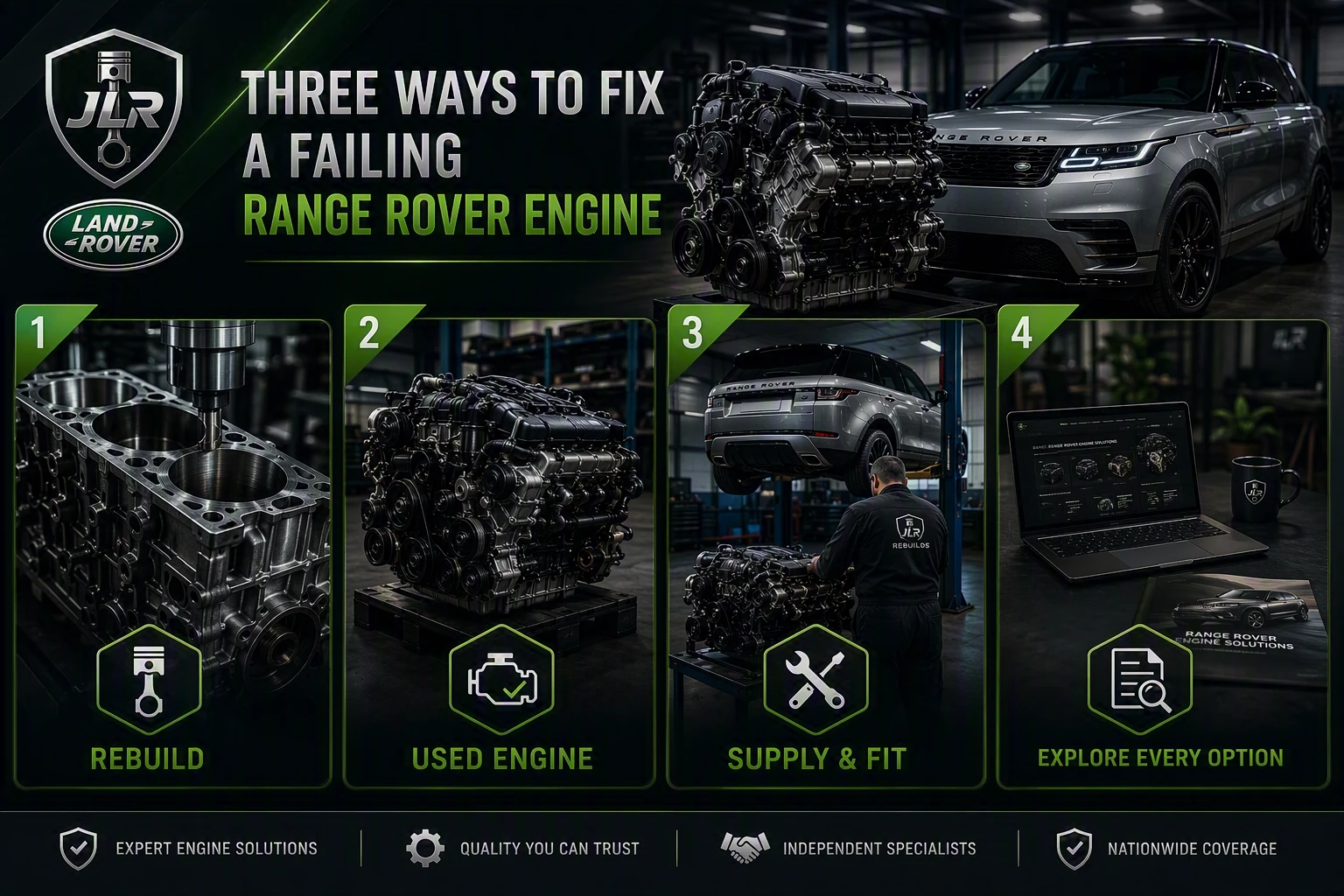
Rebuild
your original engine machined and rebuilt to tolerance; the right call when the block is salvageable and you want to keep the vehicle's original engine and identity.
Used Engine
a tested, mileage-verified unit fitted in place of yours; usually the fastest route when the block is beyond repair.
Supply & Fit
one workshop sources and fits the replacement end-to-end with a single contract and warranty.
Explore each route for Range Rover in detail on the dedicated pages.
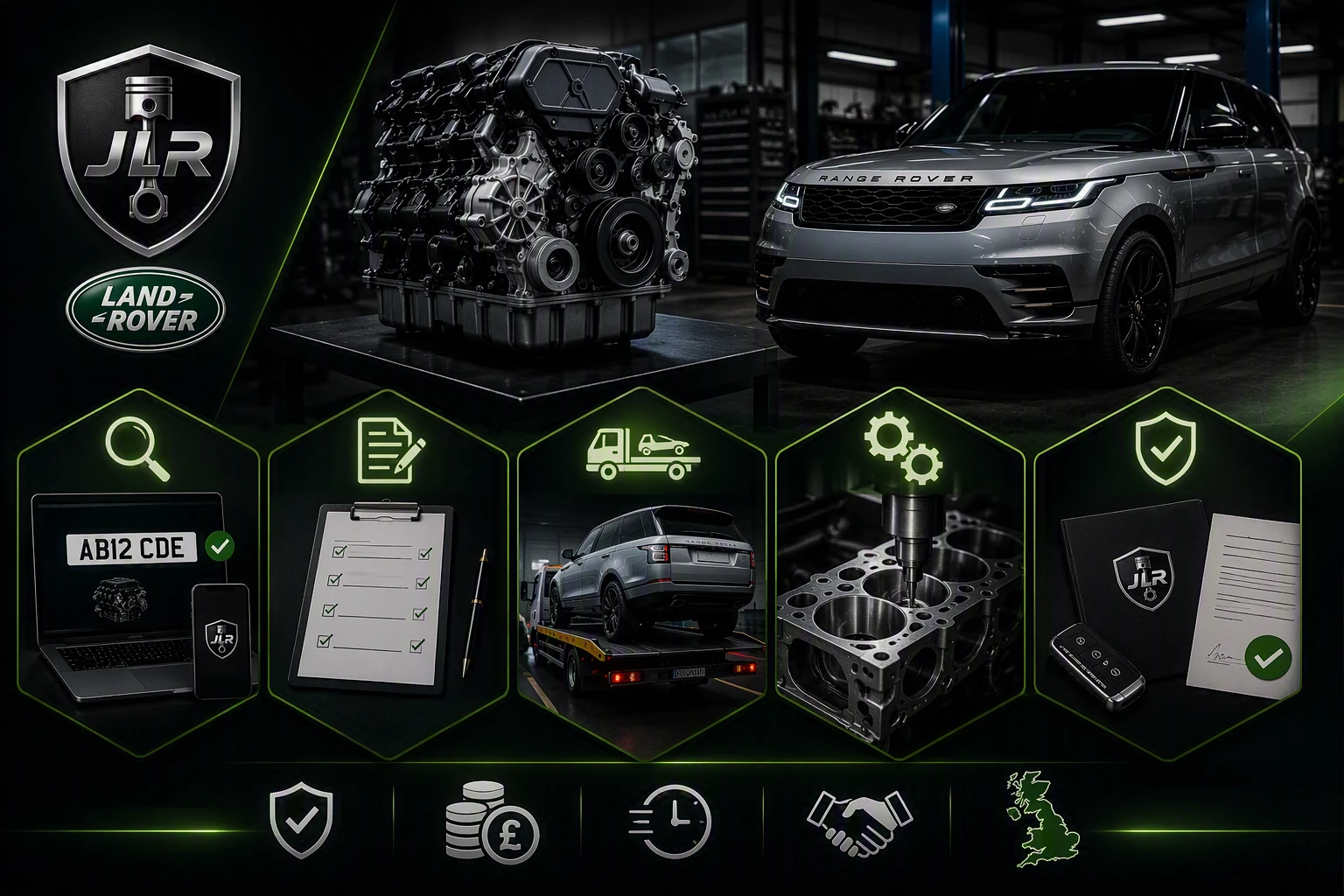
How the Range Rover Engine Matching Process Works
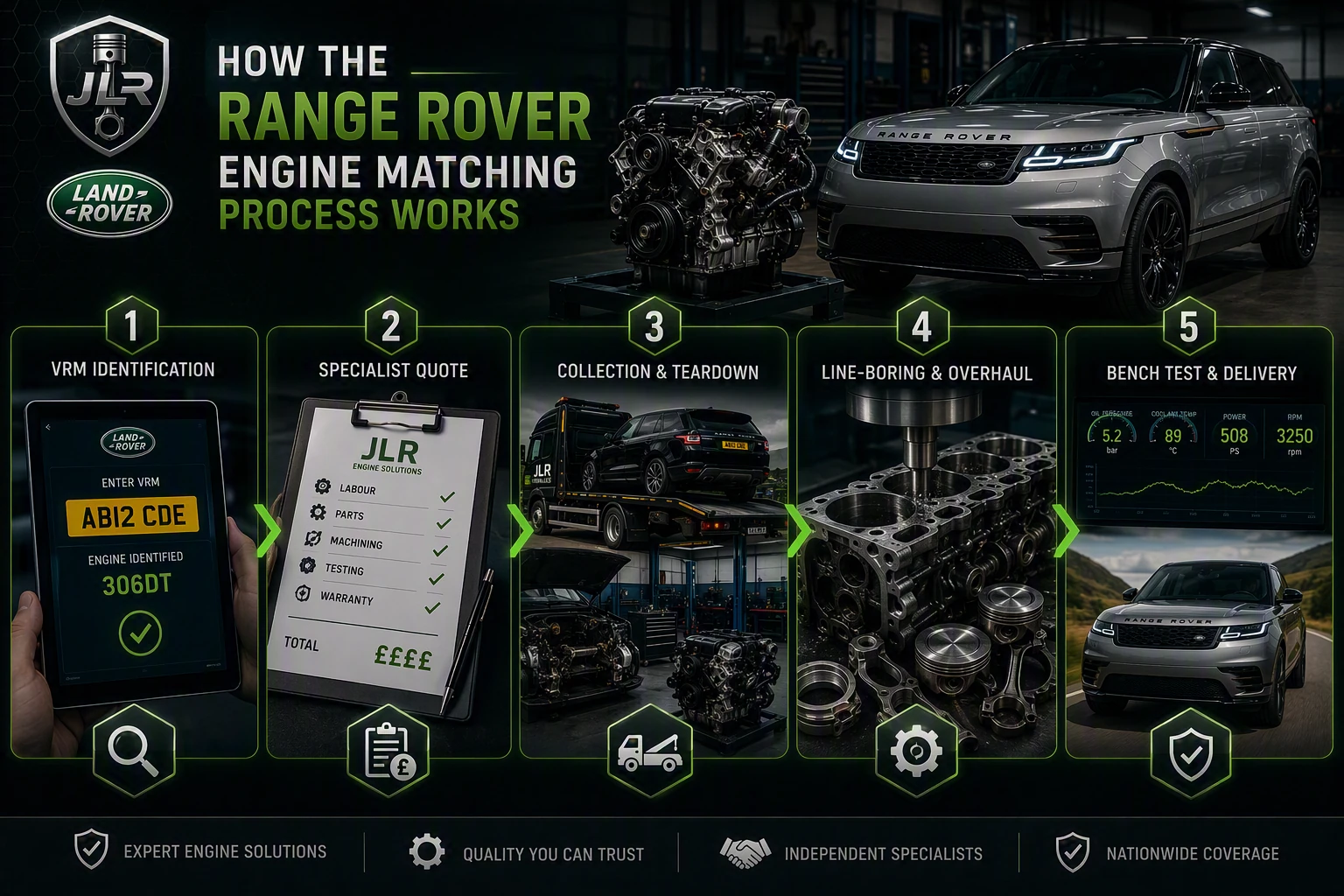
VRM Identification
your registration helps identify the likely engine code; the workshop confirms it (306DT, 448DT, 508PS, 204DTD and so on).
Specialist Quote
independent Range Rover engine specialists respond with written, itemised quotes.
Collection & Teardown
the vehicle is recovered where agreed and the engine stripped to confirm the fault.
Line-Boring & Overhaul
the block is machined and rebuilt with upgraded parts, or the replacement route confirmed.
Bench Test & Delivery
the engine is tested, the vehicle returned road-tested, and warranty paperwork handed over.
Important Disclosures
- We match enquiries with independent workshops. Your selected workshop diagnoses, quotes, contracts, invoices and warrants the work directly.
- Warranty terms depend on the unit type and are issued in writing by the selected workshop.
- Timeframes are confirmed after diagnosis and depend on parts availability and authorisation.
- Customers across mainland UK can be matched with independent specialists. We do not operate company-owned branches in every town.
- This website is a lead-matching service. We do not sell or fit engines directly.
Next Step Before You Authorise Work
Begin your Range Rover request with the registration and the symptoms you have noticed. The workshop must confirm the engine code and set out the proposed work, price, timing and warranty terms before authorisation.
Frequently Asked Questions About Range Rover Engine Rebuild in the UK
What are the most common Range Rover engine problems?
The 3.0 TDV6/SDV6 (306DT) crankshaft snapping is the most notorious, typically between 60,000 and 120,000 miles, often preceded by a low knock under load. The 4.4 SDV8 (448DT) suffers twin-turbo failure and piston ring wear. The 5.0 supercharged V8 (508PS) develops coolant pipe ruptures and timing chain guide wear, and 2.0 Ingenium units in later models stretch their timing chains. Each has warning signs — see the engine problems guide for the full symptom list.
Which Range Rover engines are most reliable?
Reliability is relative, and service history matters more than the badge on the engine. Among the common units, the 2.0 Ingenium is generally lighter on fuel but prone to chain stretch if oil changes are missed; the 3.0 TDV6 is a strong unit until the crank fails; the 5.0 supercharged V8 is robust mechanically but vulnerable to coolant system failures. The honest answer: any of them can be made reliable with correct maintenance, and any of them can fail early when neglected.
How much does a Range Rover engine rebuild typically cost?
Depending on the engine and the extent of damage, a Range Rover engine rebuild has pricing confirmed after diagnosis. A 3.0 SDV6 rebuild with a forged crank is usually at the lower-middle end; a 5.0 supercharged V8 with coolant damage can push higher. These are estimates — your itemised quote depends on diagnosis, and the cost guide page breaks down each engine family in detail.
Do all Range Rover models use the same engine?
No. The Evoque uses the 2.2 Duratorq (224DT) in early cars and 2.0 Ingenium (204DTD) later; the Sport spans the 3.0 TDV6/SDV6, 4.4 SDV8 and 5.0 supercharged V8; the Vogue overlaps those families; and the Velar is largely 2.0 Ingenium territory. That is why the registration check matters — the wrong engine code is a guaranteed headache.
Are older or newer Range Rover engines more failure-prone?
Each generation has its own weaknesses. The older 3.0 TDV6 crank failure is a known quantity with well-understood warning signs. The newer 2.0 Ingenium fails differently — timing chain stretch and balance shaft bearings — often on lower-mileage cars, which catches owners by surprise. Neither is 'safe'; both are predictable if you know what to listen for.
What's a typical Range Rover engine's lifespan?
With correct maintenance, many Range Rover engines exceed 150,000 miles. The caveat is that the common failures — TDV6 crank snap, Ingenium chain stretch — can strike well before that if oil changes are neglected, and the 5.0 V8's coolant system can end an otherwise healthy engine quickly. Lifespan is set by maintenance and early diagnosis more than by any mileage figure.
Can I get a used Range Rover engine with a warranty?
Yes — written workshop warranty terms for qualifying used engines, issued by the workshop that supplies and fits the unit. The unit is compression-tested and mileage-verified before fitment, and the engine code is confirmed against your registration. Written terms apply, and you should ask how a claim is handled before authorising.
What symptoms suggest my Range Rover needs urgent attention?
A low, irregular knock under load (often the crank or main bearing on the 3.0 diesel), metallic rattle on cold start (2.0 Ingenium chain), coolant loss with no visible leak (5.0 V8 crossover pipe), oil dilution with a diesel smell, or a sudden low oil pressure warning. Any of these means stop driving and book a diagnostic — catching it early can save the block and thousands of pounds.
Is it worth rebuilding a Range Rover engine, or should I scrap the car?
It depends on the vehicle's value and the extent of the damage. A 2015+ Range Rover Sport or Velar is almost always worth fixing — the car is worth more than the repair. An older, high-mileage example with a completely destroyed block may not justify a rebuild, and a tested used engine or supply-and-fit may be the sensible route. Your specialist prices both options after diagnosis so you decide with numbers, not emotion.
Can a non-running Range Rover be collected for engine work?
Yes — most of our matched specialists offer collection and recovery for non-running vehicles, arranged as part of the quote. You confirm the collection address and the vehicle's condition, and the workshop handles transport. Distance is rarely a barrier across mainland UK, and the recovery cost is confirmed in writing before you commit.